
Brother’s Cancer Diagnosis Shaped Senior’s Path Into Medicine
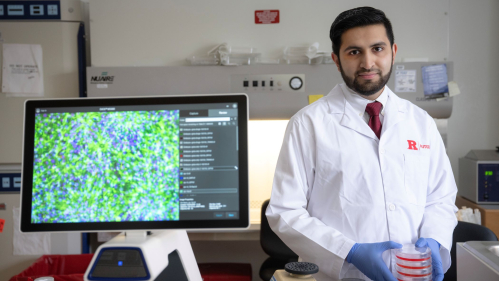
Luis Sanchez-Gonzalez earned a near-perfect score on the MCATs and spent time as an undergraduate conducting cancer research
Luis Sanchez-Gonzalez was just four years old when his older brother was diagnosed with non-Hodgkin’s lymphoma. He didn’t understand the diagnosis, but he saw the effect it had on his family.
“I didn’t know what cancer was,” said Sanchez-Gonzalez, “But I knew something was very wrong, and I remember wishing, even as a kid, that I could make it better.”
This spring, Sanchez-Gonzalez is graduating from Rutgers University-New Brunswick and preparing to spend the next four years in medical school after achieving an almost-perfect score on the Medical College Admission Test (MCAT). He is one of only about 90 individuals out of 85,000 who took the test to rank in the 100th percentile.
In addition to his high score, Sanchez-Gonzalez stands out for speaking seven languages, including Spanish, Italian, French, German, Portuguese, and Japanese, with additional proficiency in Mandarin – a skill he hopes to use to improve how patients experience care.
He learned the importance of communication while his brother was being treated. Growing up in Gloucester County as the son of Mexican immigrants, Sanchez-Gonzalez and his siblings often translated at doctor visits for his parents.
“My parents would rely on us at appointments,” he said. “Sometimes I could tell there were misunderstandings, small things that could make a big difference. That really stayed with me.”
Those moments shaped Sanchez-Gonzalez just as much as his brother’s illness. What began as a necessity became a passion for being multilingual.
“I realized early on that language can directly affect the quality of care someone receives,” said Sanchez-Gonzalez, who will earn a degree from the School of Arts and Sciences in cell biology and neuroscience with minors in chemistry, mathematics and Linguistics. “I want to be able to bridge that gap.”
The academic path Sanchez-Gonzalez took at Rutgers reflects both his scientific drive and his interest in language and communications. He said his growing interest in science happened as his brother, who is 10 years older, recovered.
“I remember him handing me a laminated periodic table and realizing, for the first time, that the natural world could be understood, organized and studied,” said Sanchez-Gonzalez, who is also a student at the Rutgers–New Brunswick Honors College.
He plans to pursue a dual M.D./Ph.D. degree in medical school after leaving Rutgers, combining patient care with research.
“I’ve always known I wanted to go into medicine,” he said. “But discovering research showed me there’s a way to do both.”
Over the past two years, Sanchez-Gonzalez has been involved in cancer research at the Child Health Institute of New Jersey, where he has spent more than 2,400 hours studying Ewing sarcoma, a rare pediatric cancer. Working under Arnold B. Rabson, director of the CHINJ, and Hsin-Ching Lin, research teaching specialist, Sanchez-Gonzalez has explored how specific drug treatments affect cancer cell behavior.
“Research is the most powerful way we have to expand what we know,” he said. “It’s how we move from understanding disease to actually improving how we treat it.”
His work includes growing cancer cells in the lab and using computer tools to study how they function. He is working to identify weak points in the cells that could lead to new treatments.
“That’s what excites me,” he said. “Not just learning existing knowledge, but being part of discovering something new that could help people.”
His research has been recognized with multiple awards and presentations. In 2025, he was inducted into the Phi Beta Kappa Society, the oldest academic honor society in the United States.
“From the start, Luis stood out for his sharp intellect, energy, and enthusiasm, quickly mastering complex data and literature while asking insightful, meaningful questions,” said Rabson, who is also a professor of pharmacology, pediatrics and pathology and laboratory medicine at Robert Wood Johnson Medical School. “He developed a level of critical thinking and scientific independence that few undergraduates achieve. His passion for science and commitment to helping patients make him exceptionally well suited for an M.D./Ph.D. program.”
Outside the lab, Sanchez-Gonzalez has dedicated himself to helping others succeed through Rutgers’ ODASIS program that provides support for pre-medical students and works to increase the recruitment and academic success of educationally and economically disadvantaged students interested in pursuing careers in science, technology, engineering and mathematics. He said the support both he and his brother, who also went through the program, received from program director Kamal Khan gave them the opportunity to succeed.
“I know how difficult those classes can be,” he said. “When I saw my MCAT score, I felt that surely it was a dream or a mistake. I wanted to help other students feel confident in their ability to succeed.”
Sanchez-Gonzalez said his goals are personal. As he starts his new academic journey, his older brother, whose diagnosis first inspired him, is completing advanced medical training in pediatric oncology.
“In a way, that experience shaped both of our lives,” Sanchez-Gonzalez said. “It started as something really difficult, but it gave us a sense of purpose.”
That purpose, he said, hasn’t changed.
“I want to be part of the work that makes experiences like that less common,” he said. “And when they do happen, I want patients and families to have better options, better understanding and better care.”