
A First-Generation Student Bridges Disciplines and Finds Mentorship at the School of Public Health
Rutgers graduate student Abanoub J. Armanious forges his own path – one defined by determination and a commitment to meaningful impact
For Abanoub Armanious, the journey to public health wasn’t mapped out in advance.
As a first-generation graduate student at Rutgers School of Public Health, he built his path step by step, guided by mentorship, lived experience and a deep commitment to ensuring research reflects the people it is meant to serve.
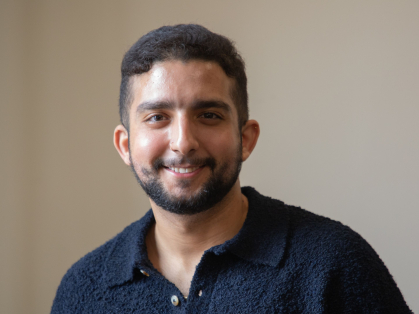
In May, Armanious will graduate with a master of science degree in epidemiology with a concentration in pharmacoepidemiology, after a graduate career marked by academic excellence and interdisciplinary research at the intersection of neuropsychiatry, pharmacoepidemiology and patient behavior.
From peer-reviewed studies on medications, such as antidiabetic and weight-loss drug semaglutide and attention-deficit/hyperactivity disorder treatment lisdexamfetamine, to international scientific recognition, his accomplishments tell one story.
But for Armanious, the more important story is how he got there and the people who helped along the way. He discusses the experiences that shaped his journey.
What inspired you to pursue public health, and how did being a first-generation graduate shape your path in public health?
Before graduate school, my work already felt like a career to me. When I joined Morgan H. James's lab in May 2021 as an undergraduate, I stopped treating school and “real life” as separate stages. Every step, academic or professional, became an act of stewardship for a future I was actively building.
The path to public health emerged from that work itself. I started in pre-clinical neuropsychiatric drug development, where rodent models could tell me a great deal about a compound’s pharmacology but little about what living with a medication actually feels like. So, I built a parallel line of research analyzing patient-reported outcomes, and the master’s program followed naturally as the way to take that bridging work to the population scale.
Being first-generation has been inseparable from that ethic. Without a path laid out for me, I had to design as I lived, but I’ve come to see that absence as a strange kind of clarity. A path already paved tends to disappear beneath your feet. A chosen step-by-step path has to be defended.
What has been the most rewarding or transformative experience during your time at the School of Public Health?
Many experiences have shaped my time at Rutgers, but none has reshaped my thinking quite like the couple of weeks I spent in Manizales, Colombia, through the “Addressing Health Inequities in Latin American Communities” course led by Rafael E. Pérez-Figueroa alongside Michelle Ruidíaz-Santiago.
Without a path laid out for me, I had to design as I lived, but I’ve come to see that absence as a strange kind of clarity. A path already paved tends to disappear beneath your feet. A chosen step-by-step path has to be defended.
The trip taught me something coursework alone could not. Public health is, at its core, an act of translation. Walking through Manizales's central market, sitting with organizers from Nutrir and Chispas de Esperanza, and being welcomed into a partnership with Universidad Autónoma de Manizales were not data points to me. They were reminders that no method, however rigorous, is complete until it has been measured against the lived knowledge of the communities it claims to serve.
That conviction now reorganizes how I think about my own work in pharmacoepidemiology, where the same drug, dose and diagnosis can mean entirely different things depending on the context in which a person lives.
What advice would you give to current and future public health students, and what would you want other first-generation students to take away from your journey?
Refuse the false choice between ambition and humility.
You will be told, sometimes subtly, that you must either out-credential the room or shrink into it. Both are losing strategies. The deeper task is to claim your seat, or build your own, and then keep one pulled out beside you. That has been my experience of mentorship at Rutgers. Claire Brown, the director for student experiences and alumni affairs, in particular, served as a mentor in my first year and modeled what it looks like to invest in someone before they have proven anything.
That investment has continued throughout my graduate training, from the classroom to the broader pharmacoepidemiology and treatment sciences community. This kind of generosity is not repaid by accepting it, though, but only by passing it on.
So, for first-generation students especially, I would emphasize that you must claim what you have been doing all along as a method. The years you spent translating between the home you came from and the institutions you entered are not your biography. They are practice. Holding two contexts in mind at once is the same discipline public health asks of us when we move between data and lived experience, and it is exactly what the field needs more of.
What's next after graduation, and how do you hope to make an impact in public health?
For first-generation students especially, I would emphasize that you must claim what you have been doing all along as a method. The years you spent translating between the home you came from and the institutions you entered are not your biography.
I plan to continue my work with Morgan James and Gary Aston-Jones at Rutgers Robert Wood Johnson Medical School while I explore different clinical psychiatry research positions for the next step in my training.
My longer-term goal is to pursue a doctorate in computational psychiatry, ideally in an environment that encourages interdisciplinary work. I’m working before applying because it’s not a default next step. It’s a commitment that deserves its own deliberate “yes.”
The question driving my work right now is how mechanistic insights from preclinical neuroscience and population-level pharmacoepidemiology speak to one another, and what patient-reported experiences reveal that neither approach can fully capture.
My hope is to spend my career at that intersection. I ultimately want to help build methods that take patients’ lived realities as seriously as we take their biology, so that the treatments we develop and the prescribing decisions we make actually fit the people who live with them.