Robert Wood Johnson Medical School’s new home brings students and educators together and connects research labs with biomedical entrepreneurs
The Raritan River divided Robert Wood Johnson Medical School for decades.
First- and second-year students mostly studied in Piscataway, N.J., in classrooms. Third- and fourth-year students mostly trained in New Brunswick, N.J., in clinics.
This year, students at every stage of training are in New Brunswick, a short walk from each other and from the school’s major clinical partner Robert Wood Johnson University Hospital—a change school leaders think will significantly improve everyone’s experience.
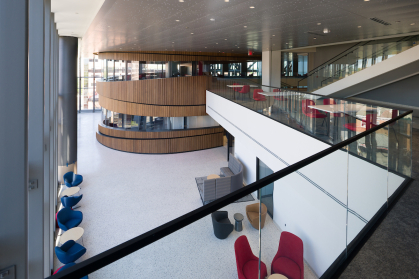
The school occupies four of 12 floors in the first tower of developer DEVCO’s Health + Life Science Exchange (HELIX). Cutting-edge facilities include an anatomy lab and a 14,500-square-foot simulation center in addition to classrooms and study space. Rutgers translational research laboratories fill the floors below, while those above will house start-up companies, many of them commercializing Rutgers intellectual property.
Dean Amy Murtha, who will be founding dean of the future Rutgers School of Medicine, said the old arrangement kept new med students away from the clinical environment and kept students further along in the program away from training tools in Piscataway.
Now, first- and second-year students can walk to the hospital to see clinical care. Students in their final two years, who spend most of their time on hospital rotations, can walk to the HELIX for simulation training that lets them rehearse the skills they’ll need as residents and for exams with actors trained to portray standardized patients.
“It’s so important that we’re together, and that we take away that barrier that we’ve had historically,” Murtha said. “The move creates an opportunity to build community across all of our students and all of our faculty, now and looking forward to the future Rutgers School of Medicine.”
The new space will house the New Brunswick campus of that school, which will unite Robert Wood Johnson Medical School and New Jersey Medical School. Pending accreditation in 2027 from the Liaison Committee on Medical Education, the accrediting body for medical education programs, the first class of the unified school is expected to enroll in 2028 at what would become one of the nation’s largest medical schools in the country based on enrollment.
Practicing for Patients
The simulation center’s clinical skills suite has 20 spaces set up as medical exam rooms, each with microphones and cameras. Students interview and examine standardized patients (actors trained to present specific cases), often with the aid of technology such as QR codes that may be scanned with their smartphones to hear realistic heart, lung, and other clinical sounds consistent with the condition the actor is portraying.
Faculty, hidden behind one-way glass, observe and grade the encounters.
Murtha said the rooms create “an opportunity for students to make mistakes, get feedback and fix those mistakes.”
“Sitting in a classroom and listening to lectures and taking exams are important because you need content to understand,” she said. “But really, what makes you a good doctor is being able to ask the right questions, to be able to listen carefully to what the patients share with you.”
One of the cameras in each exam room focuses on the “patient” and the other on the student, so that faculty can see the body language of both.
“The system stores video of every exam, along with notes and grades from each session, so faculty can longitudinally follow a learner from day one of medical school to even beyond graduation, if they stay with us as a resident,” said Colleen Donovan, an associate professor of emergency medicine and the medical school’s simulation director.
The trauma setting adds another kind of realism: equipment students will encounter in clinical practice, including ventilators, ultrasound systems and an anesthesia machine. There are scenarios in which a manikin can simulate respiratory distress while on a real ventilator, with parts contracting to make insertion difficult, requiring learners to interpret the machine’s readings and make clinical decisions.
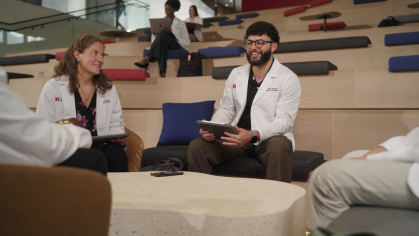
The facilities also are designed for students from different health professions to train together. Pharmacy students on clinical rotations, for example, could join medical students in simulations involving medication decisions and emergency care.
“In addition to allowing our students to do far more simulation work, and far more realistic simulation work, the new space will let our students work with students from other schools,” said Les Barta, director of the simulation technology program at the Ernest Mario School of Pharmacy, who helped plan the simulation center in the HELIX. “This further adds to the realism because medicine today is almost always done in interdisciplinary teams, where physicians are working with nurses and pharmacists and others.”
Technology Tidbits
The new medical school facility features a long list of new teaching technologies and improvements that faculty members have long dreamed of.
Inside the anatomy lab, for example, instructors perform dissections on camera. Nearby students can follow the demonstration on monitors while performing their own dissections, seeing details that might otherwise be difficult to observe in a crowded group around an instructor.
There is also an immersive studio designed to simulate pretty much any setting. Projected images, responsive walls, sound, lighting and scent can recreate an operating room, a patient’s apartment, a roadside emergency or in the middle of a flight, when someone asks if there’s a doctor or a nurse on the plane.
Even smell has an educational purpose. In the immersive studio, simulated scents associated with burns or surgical electrocautery can help prepare students for an unfamiliar sensory experience that may otherwise be startling when they first encounter it in clinical care.
Rutgers Health Space Below
The principle of bringing together different kinds of expertise also shapes the research spaces on the floors below the medical school’s academic areas. Much of the space will be shared by four different research centers, the Rutgers Institute for Translational Medicine and Science, whose focus is to translate innovations into new therapeutics, devices and software to improve health regionally, nationally and globally. The space leverages all disciplines, schools and centers of Rutgers Health.
The floors revolve around “neighborhoods” that combine wet and dry laboratories under shared scientific themes. Wet laboratories support experiments with cells, tissues and other biological materials. Dry laboratories focus on computing and data analysis. Placing those researchers together is intended to encourage exchanges between researchers generating experimental findings and those interpreting large datasets.
Reynold Panettieri Jr., director of the Rutgers Institute for Translational Medicine and Science, described research groups working in areas including genetics, neuroscience and neurometabolism. The arrangements are designed to support interdisciplinary teams tackling questions that require several kinds of expertise, including teams competing for large, multi-investigator research grants.
Panettieri said the move would provide about 30% to 40% more space and expand the number of laboratories for the Rutgers Health institutes and schools.
He also described an emphasis on research using human cells, tissues and organoids, small laboratory-grown models that reproduce features of human organs. The aim is to help experimental discoveries inform approaches to human disease and potential treatments.
“We want to get new biomarkers, new therapies into patients faster,” Panettieri said.
Panettieri and other lab leaders hope the new lab space will also help them with another goal: forging ties between research scientists and medical students. Research that expands medical knowledge and makes better treatments possible is one of the school’s core missions, and school leaders want to give students a bigger taste of lab research, so they know if they want to make it part of their medical work.
The distance between the old labs and classrooms divided those two parts of the school, but once again, the new space has created physical proximity designed to benefit everyone.