
Camp for Teens With Spinal Cord Injuries Helps Build Independence
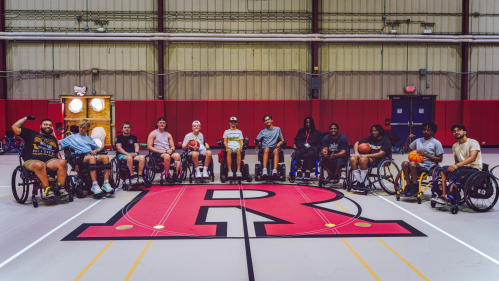
The first-of-its-kind residential camp offers life-changing lessons and training for health care professionals
Before coming to True Grit summer camp at Rutgers, Anthony Guzman had not left the house by himself for years following his spinal cord injury at 13, and he relied on others for everyday routines.
Guzman, now 19, just got his driver’s license, has a job at a movie theater near his Lawrence, Mass., home and will begin college this fall at the University of Massachusetts, majoring in accounting.
“True Grit showed him that he can be outside the house, he can dorm, he can live independently,” his mother, Raquel Ozoria, said. “It changed his outlook on life. It gave him a boost of confidence.”
True Grit – offered by Rutgers School of Health Professions and Children’s Specialized Hospital, part of the Children’s Health Network of RWJBarnabas Health – is a first-of-its-kind residential summer camp for those 16 to 21 with spinal cord injuries. The program is designed to teach young adults to learn to transition to adulthood, including living independently, attending college, developing relationships, and entering the workforce. Participants, who spend a week at the dorms on Rutgers’ Livingston campus in Piscataway, N.J., only pay a $50 registration fee. The program’s cost is covered by expense-sharing between Rutgers and Children’s Specialized Hospital as well as grants from private donors and nonprofits. Program staffing is supported by Children’s Specialized Hospital clinicians, Rutgers students across multiple schools and programs, and volunteer clinicians from the tri-state area.
“Nationally, there is no program like this,” said Keara McNair, who co-directs True Grit with Kassandra Boyd, an occupational therapist at Children’s Specialized Hospital and the driving force behind the camp. “The programs that exist are either medical – you’re going for a day treatment, or you’re getting therapy, but there’s no community – or it’s an out-of-pocket expense, so there’s a barrier for participation.”
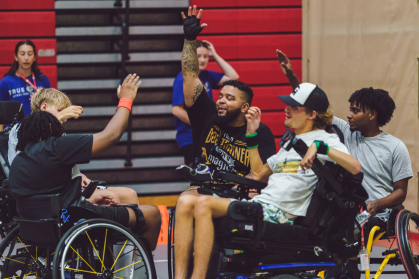
The program began in 2024 with six participants, grew to nine last year, and will host 15 young adults and 5 peer mentors next week when it starts Sunday, McNair said. The campers come from across the country, including this year from Illinois, Indiana and Minnesota, and for the first time there are three female participants.
Those living with spinal cord injuries are getting older – the average age at injury has increased from 29 in 1970s to about 44 years old since 2015, according to the National Spinal Cord Statistical Center. For that reason, McNair said, much of the care has focused on services for older patients, but 16- to 21-year-olds make up about 20 percent of the population living with spinal cord injuries.
“Our participants say they want to connect with people who have similar lived experiences,” said McNair, who is also an assistant professor in the school’s Department of Rehabilitation and Movement Sciences. “Having an injury at 16 or 17 when you’re not quite sure what your identity is, it’s very different from having an injury when you’re already married at 36, or you’re employed, or may have kids.”
Guzman said before arriving at Rutgers in 2024, he was anxious being away from his home and nervous about how he would make it through the week without his mom nearby. By the end of the week, he learned important lessons from the experts at the camp for independent living. But what changed his perspective was seeing his peers navigating the world in a wheelchair.
“It was more about seeing the people there, and seeing what’s possible,” said Guzman, who is returning for the third time. “They’re in college, they’re driving, and they’re doing all this stuff; that motivated me.”
He said he returned to the camp to stay motivated and to inspire others who are coming after him.
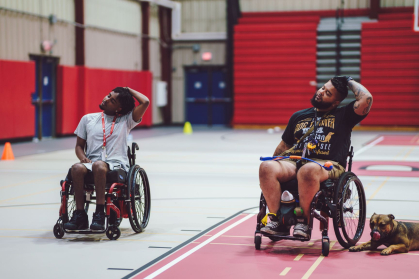
True Grit is the brainchild of Boyd, who as an occupational therapist with the spinal cord injury team at the Children’s Specialized Hospital, saw the gap in support services after her young patients left her care.
“It became this recurring theme that despite having such a strong team of clinicians and having all the tools and all the specialized care, we knew that we were sending these teens and their families back home needing more, that life with a spinal cord injury is so much more than just being able to safely leave the hospital,” Boyd said. “There wasn’t a program or anything available to give these families a second chance to have peer support, to try these adaptive services, so I knew I just needed to create it.”
Boyd also knew it would be a massive undertaking, and that she would need more education on how to get a program like this off the ground. So, she decided to return to school to get her doctorate in program development. As Boyd was creating the framework for the program she envisioned, she soon realized she needed Rutgers to become a partner. Rutgers would provide the resources to keep costs down for the participants and the dorm space to make it a residential program, but more importantly, the program could train the next generation of health care professionals to consider entering the field of spinal cord injury care.
“One of the other big problems with spinal cord injuries is there’s such a lack of expert care available, so we wanted to expose and train as many people as we can,” Boyd said.
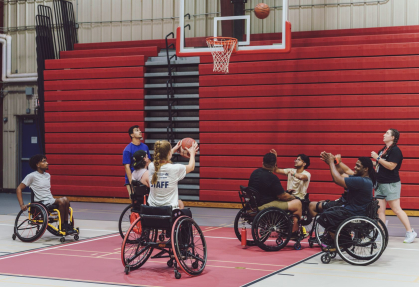
It was through True Grit that Rutgers alumna Corrine Calvanico ended up working as an occupational therapist on the spinal cord rehab team at Children’s Specialized. Calvanico, a 2022 graduate who also received her occupational therapy doctorate from Rutgers last year, knew she wanted to work in pediatric inpatient therapy, but hadn’t considered working with the spinal cord injury population. Calvanico, of Hoboken, N.J., learned about True Grit during her doctoral program from McNair, who was one of her professors then.
“True Grit showed me that my role as an occupational therapist is more than therapy,” said Calvanico, who has been involved in the program since the first camp in 2024. “We have to prepare these kids for discharge and to be out in the community. It gave me more of a community-based lens.”
Ozoria said Guzman entered True Grit as a shy, self-conscious, and reserved teenager.
“He came back outgoing, wanting to do everything himself,” she said. “It changed his life. It showed him he was able to do so much.”