
Rutgers Leaders Are Recognized as Most Influential Health Care Leaders in New Jersey

Business journal NJBIZ’s list includes a chancellor, deans, institute and center directors, and the leader of the state’s poison control center
Interim chancellor of Rutgers Health Robert Johnson was recognized as the “longest-serving medical school dean in the nation” as one of several leaders in the field from Rutgers to earn a spotlight on the 2026 NJBIZ Health Care Power List, which identifies the top influencers in health care in New Jersey.
Johnson, who also served as dean of Rutgers New Jersey Medical School, was highlighted for his leading efforts in HIV/AIDS prevention, testing and public education and helping shape how communities responded to the epidemic. Johnson was recognized as president of the New Jersey Board of Medical Examiners and chair of the U.S. Department of Health and Human Services’ Council on Graduate Medical Education, along with service on national advisory boards focused on public health and medical education. Johnson, interim chancellor of Rutgers Health also was noted as a recipient of the NJBIZ Healthcare Heroes Lifetime Achievement Award.
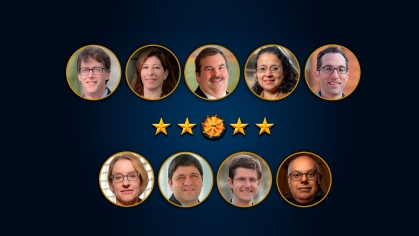
Johnson was among eight leaders from Rutgers Health lauded for their roles in educating the nation’s next generation of health care providers; for their partnerships in advancing biomedical research and treatment of disease, informing the public on health risks and influencing policy that will save lives; and serving as advocates for clinician and group well-being.
The eight Rutgers Health leaders who were recognized on the list of 76 health care leaders are:
- Robert Johnson, interim chancellor of Rutgers Health, and dean, Rutgers New Jersey Medical School
- Diane Calello, executive and medical director of the New Jersey Poison Control Center based at Rutgers New Jersey Medical School
- Joel Cantor, Distinguished Professor of Public Policy and the founding director of the Center for State Health Policy
- Vicente Gracias, senior vice chancellor for clinical affairs and vice president for health affairs, Rutgers University and Chief Academic Officer, RWJBarnabas Health
- Perry N. Halkitis, dean, Rutgers School of Public Health, and Hunterdon Professor of Public Health and Health Equity
- Deanna Kerrigan, vice dean, Henry Rutgers Chair of Whole Person Health and professor at Rutgers School of Public Health
- Steven K. Libutti, the William N. Hait Director of Rutgers Cancer Institute and the senior vice president of oncology services, RWJBarnabas Health
- Amy Murtha, dean, Rutgers Robert Wood Johnson Medical School
The list included Mark Manigan, president and chief executive of one of Rutgers University’s clinical partners, RWJBarnabas Health.
The Rutgers Health leaders were lauded for their roles in educating the nation’s next generation of health care providers; for their partnerships in advancing biomedical research and treatment of disease, informing the public on health risks and influencing policy that will save lives; and serving as advocates for clinician and group well-being.
Calello was recognized for her leadership as the executive and medical director of the New Jersey Poison Information and Education System (NJPIES) — also known as the New Jersey Poison Control Center — which annually manages about 54,000 cases, providing real-time clinical guidance to families, caregivers and medical professionals. The journal notes Calello is “particularly active in addressing issues such as pediatric poisoning, environmental lead exposure and the health impacts of the opioid epidemic.”
Cantor, the founding director of the Rutgers Center for State Health Policy and a longtime leader in health policy research, was honored for guiding the center since its creation in 1999. “Over more than two decades, Cantor has built the center into a nationally recognized hub for data-driven policy analysis, leading major initiatives on population health, health equity and outcomes for vulnerable populations,” the journal wrote. “His work has been supported by leading institutions including the National Institutes of Health and the Robert Wood Johnson Foundation, and he has earned recognition such as Rutgers’ President’s Award for Research in Service to New Jersey.”
Gracias was named for his leadership as a professor of surgery and senior vice chancellor for clinical affairs at Rutgers Health and vice president of health affairs at Rutgers University in addition to his leadership responsibilities within RWJBarnabas Health. “Through his roles, he provides strategic oversight across one of New Jersey’s largest academic health systems, working closely with deans, faculty leaders and clinical partners to advance integration, quality and excellence across patient care, education and research,” the journal wrote.
Additionally, Gracias was cited as an advocate for clinician well-being, specifically for establishing Rutgers Health’s Office for the Promotion of Well-Being in 2024. “Gracias is certified as a global instructor in mindfulness-based emotional intelligence and continues to champion initiatives that strengthen workforce resilience and culture,” the journal noted.
Halkitis was credited for using his expertise as an infectious disease epidemiologist, applied statistician and public health psychologist to further research, teaching and activism. “Halkitis has written six books and 300 peer-reviewed academic articles and has been the editor in chief of Behavioral Medicine since 2013 and is the founding editor in chief of Annals of LGBTQ Public and Population Health,” the journal noted. “He also actively disseminates knowledge to mainstream media, appearing frequently on television, radio, print and podcasts. In his latest book, Humanizing Public Health: How Disease-Centered Approaches Have Failed Us, Halkitis examines lessons from the HIV and COVID-19 pandemics and calls for a fundamental shift in the approach to public health.”
Kerrigan was cited for founding the Rutgers Center for Whole Person, which conducts research, training and practice examining the interconnectedness of body, mind and spirit. “The center focuses on individual and collective health. It also explores how the approach can help bring together the social fabric, serving to challenge social and structural barriers to holistic health across settings,” the journal noted. Kerrigan was also listed for her work as co-director of the NIMH T32 pre-doctoral training program in Approaches to Address Social-Structural Factors Related to HIV.
Libutti, the William N. Hait director of Rutgers Cancer Institute and senior vice president of oncology services for RWJBarnabas Health, was selected for his leadership in oncology research and care, including the development and oversight of the new Jack & Sheryl Morris Cancer Center – the state’s first freestanding cancer hospital and one of just 13 nationwide. “Libutti is an expert in the management of neuroendocrine tumors, a past president of the American Association of Endocrine Surgeons and a member of American Surgical Association and Association of American Physicians,” the journal wrote. “The holder of 11 patents, Libutti’s work focuses on developing novel cancer therapies via understanding of the tumor microenvironment and a better understanding of the tumor suppressor genes MEN1 and FILIP1L.”
The journal recognized Murtha for her leadership as the founding dean of the future Rutgers School of Medicine, which will be created through the unification of Rutgers’ two medical schools, New Jersey Medical School and Robert Wood Johnson Medical School, and pending Liaison Committee on Medical Education certification. “At its launch, Murtha will lead one of the largest public medical schools in the country,” the journal wrote. “Leading up to the combination, Murtha has embarked on a listening tour over the past two years to inform the institution, engaging faculty, staff, students and constituents.”
NJBIZ also recognized Murtha for her work as a leading maternal-fetal medicine specialist. The journal noted: “Throughout her career, Murtha has upheld a commitment to advancing health equity through her research, inclusive clinical care and leadership.”